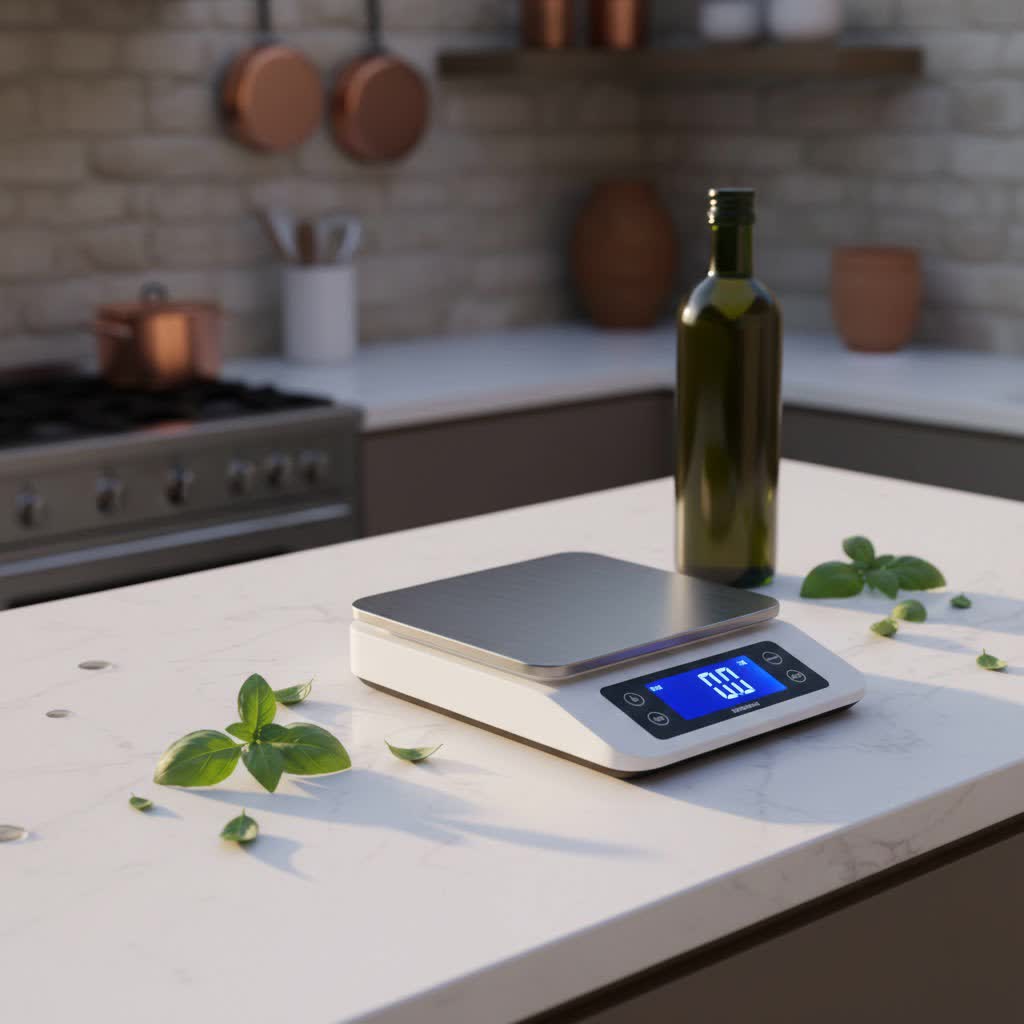
In the world of cooking and baking, precision is often the unspoken ingredient that elevates a dish from good to truly exceptional. While many home cooks rely on guesswork or volumetric measurements, the seasoned chef understands that the subtle difference of a few grams can profoundly impact texture, flavor, and consistency. This guide delves into the indispensable tool that brings this level of exactitude to your kitchen: the precision kitchen scale.
Why You Need a Precision Kitchen Scale
Accurate measurement is the cornerstone of successful cooking, especially in baking where recipes are more akin to scientific formulas than artistic expressions. Unlike measuring cups and spoons, which can vary significantly depending on how ingredients are packed, a precision kitchen scale provides undeniable consistency. This meticulous approach ensures that your delicate pastries rise perfectly, your bread has the ideal crumb, and your complex sauces achieve the intended balance of flavors every single time.
Using a precision scale offers several tangible benefits over traditional methods. It guarantees repeatability, meaning your favorite dishes will taste just as good today as they did yesterday. It minimizes food waste by preventing mismeasurements and ruined batches. For those mindful of nutrition, it enables precise portion control, aiding in dietary management. Furthermore, for specialty tasks like brewing the perfect cup of coffee or crafting intricate cocktails, a gram scale is not just beneficial, but absolutely essential.
Understanding Precision Kitchen Scales
What truly sets a “precision” kitchen scale apart from its more common counterparts? The defining characteristic lies in its resolution, which refers to the smallest increment of weight it can accurately detect. While standard kitchen scales typically measure in 1-gram increments and handle capacities of 5 to 10 kilograms, precision scales offer far greater granularity, usually measuring in 0.1-gram or even 0.01-gram increments.
This finer resolution comes with a trade-off: precision scales often have a lower maximum capacity, typically ranging from a few hundred grams to about 3 kilograms. This design prioritizes the accurate measurement of small quantities over the ability to weigh large volumes, making them perfect for ingredients like yeast, spices, potent extracts, or coffee beans. Most precision scales today are digital, offering clear displays and advanced features that mechanical scales cannot match.
Key Factors When Choosing a Precision Kitchen Scale
Selecting the right precision kitchen scale involves considering several critical features to match your culinary needs and workflow.
Accuracy & Resolution
The most crucial factor is the scale’s resolution.
- 0.1-gram accuracy is widely suitable for most precision tasks, including baking, general cooking, and coffee brewing. It offers enough detail to ensure consistent results without being overly sensitive.
- 0.01-gram accuracy, or “micro-precision,” is reserved for highly specialized tasks where even minute variations are critical. This might include micro-dosing powerful ingredients, weighing very small amounts of expensive spices, or laboratory-grade applications. For the average home cook, 0.1g is typically more than sufficient.
|
Our Picks for the Best Kitchen Scale in 2026
As an Amazon Associate I earn from qualifying purchases.
|
||
| Num | Product | Action |
|---|---|---|
| 1 | Etekcity Food Kitchen Scale, Digital Grams and Ounces for Weight Loss, Baking, Cooking, Keto and Meal Prep, LCD Display, Medium, 304 Stainless Steel |

|
| 2 | Etekcity Digital Food Kitchen Scale, Grams and Oz for Weight Loss, Baking and Cooking, 0.05oz/1g Precise Graduation,5 Weight Units, IPX6 Waterproof, USB Rechargeable,304 Stainless Steel-Silver, 22lb |
|
| 3 | OXO Good Grips 11-Pound Stainless Steel Kitchen Scale with Pull-Out Display - Black |
|
| 4 | Mik-Nana Food Scale, 10kg/22lb Digital Kitchen Scale Weight Grams and Ounces for Baking Cooking Coffee Package Postage, 6 Units with Tare Function, LCD Display, Easy Clean Stainless Steel |
|
| 5 | Nicewell Food Scale, 22lb Digital Kitchen Scale Weight Grams and oz for Cooking Baking, 1g/0.1oz Precise Graduation, Stainless Steel and Tempered Glass (Ash Silver) |
|
| 6 | Digital Kitchen Food Scale 33lb-Detachable LCD Display,1g/0.1oz Precise Electronic Weight Scale for Baking, Tare/Hold/Timer Function, Glass Platform, Count Mode, Wall-Mount & Tilt Stand |
|
| 7 | Food Scale -33lb Digital Kitchen Scale for Food Ounces Grams Rechargeable 304 Stainless Steel,Batteries and Type-C Charging - Perfect for Meal Prep, Cooking, and Baking, Black |
|
| 8 | Food Scale, 11lb Digital Kitchen Scale with 6 Units LCD Display and Tare Function,Compact Design for Baking,Healthy Cooking,Meal Prep, 304 Stainless Steel |
|
| 9 | Amazon Basics Digital Kitchen Scale with LCD Display, Tare Function, Multiple Units, Weighs up to 11 Pounds, Batteries Included, Black and Stainless Steel |
|
| 10 | KitchenAid KQ908 Glass Surface 11 Pound Capacity Digital Kitchen and Food Scale, Black |
|
Capacity
Consider both the maximum weight the scale can handle and its minimum effective weight (the smallest weight it can accurately register).
- Scales with capacities of 500g to 1kg are ideal for most baking tasks involving smaller batches, coffee, and spices.
- Scales with 2kg to 3kg capacity offer more versatility, allowing you to weigh larger quantities for bread dough or more substantial meal prep, while still maintaining high precision for smaller additions.
Units of Measurement
Ensure the scale offers the units you commonly use. The most common and useful units for precision cooking are:
- Grams (g): Essential for baking and coffee.
- Ounces (oz): Popular in some Western recipes.
- Pounds (lb): For larger quantities.
- Milliliters (ml): Though a volume unit, some scales can estimate the volume of water based on its density.
Essential Features
Modern precision kitchen scales come equipped with features that significantly enhance usability:
- Tare Function: This is indispensable. It allows you to zero out the weight of a container or previously added ingredients, so you can measure subsequent ingredients accurately in the same bowl.
- Backlit Display: A clear, backlit LCD screen ensures readability in various lighting conditions, a small but significant detail during busy cooking sessions.
- Auto-Off: A programmable auto-off feature helps conserve battery life by shutting down the scale after a period of inactivity.
- Platform Material: Stainless steel platforms are generally preferred for their hygiene, durability, and ease of cleaning compared to plastic.
- Power Source: Most scales run on AAA or AA batteries. Some advanced models offer USB rechargeable options, which can be more convenient and environmentally friendly.
Design & Durability
Look for a compact, slim design that won’t take up too much counter space. Durability is also key; a well-built scale with robust buttons and a stable weighing platform will withstand regular use. Ease of cleaning is also a practical consideration.
Price
Precision kitchen scales vary in price significantly. Basic 0.1g scales can be quite affordable, while professional-grade models with 0.01g accuracy, smart features, and robust construction can be a significant investment. Balance your budget with your specific needs and frequency of use.
Top Precision Kitchen Scales on the Market
When evaluating leading precision kitchen scales, you’ll find models designed for varying levels of precision and specific applications. Here’s a general comparison of what to expect:
| Feature | Ultra-Precision (e.g., 0.01g) | High-Precision (e.g., 0.1g) | Versatile Mid-Range (e.g., 0.1g) |
|---|---|---|---|
| Resolution | 0.01g | 0.1g | 0.1g |
| Max Capacity | 200-500g (often smaller) | 1000g-3000g | 3000g-5000g |
| Ideal For | Micro-dosing, jewelry, lab work, extreme precision coffee | Specialty coffee brewing, delicate baking, precise cocktails | General precision cooking, larger baking batches, portion control |
| Tare Function | Yes, highly responsive | Yes, quick and reliable | Yes, standard functionality |
| Display | Bright, often smart-enabled, some with timers | Backlit LCD, clear and easy to read | Backlit LCD |
| Connectivity | Some offer Bluetooth/app integration | Rarely, focus on core function | Rarely |
| Power | USB-rechargeable, some AAA | AAA batteries, some USB | AAA batteries |
| Material | High-grade plastics, stainless steel | Stainless steel platform, robust plastic body | Stainless steel platform, durable plastic |
| Price Range | Premium | Mid-to-High | Budget-to-Mid |
| User Rating | Often very high for specific niches | Excellent for general precision use | Good value, reliable |
How to Use and Care for Your Precision Kitchen Scale
Maximizing the lifespan and accuracy of your precision kitchen scale involves proper usage and consistent care.
Usage Tips
- Flat, Stable Surface: Always place your scale on a level, stable surface, away from vibrations or drafts that could affect readings.
- Calibrate Regularly: Many precision scales come with calibration weights or instructions for calibrating. Perform this periodically to maintain accuracy.
- Tare Before Measuring: Always turn the scale on and press the “tare” or “zero” button before placing any ingredients or containers on it. This ensures you’re only measuring the added weight.
- Add Slowly: For very precise measurements, add ingredients slowly to allow the scale’s sensor to register the weight accurately.
- Room Temperature: Ingredients at extreme temperatures can sometimes affect sensor readings. Allow ingredients to come to room temperature if possible.
Maintenance
- Clean Immediately: Wipe down the platform and body with a damp cloth after each use, especially if spills occur. Avoid abrasive cleaners.
- Avoid Submersion: Never immerse your scale in water, as this can damage the electronic components.
- Proper Storage: Store your scale in a dry place, away from extreme temperatures or humidity. Many compact models can be easily stored in a drawer.
- Battery Management: Remove batteries if the scale will not be used for an extended period to prevent corrosion. Replace batteries promptly when the low-battery indicator appears.
Troubleshooting Common Issues
- Inaccurate Readings: Check for low batteries, an uneven surface, or drafts. Ensure nothing is touching the scale’s underside.
- Display Errors: Refer to your scale’s manual for specific error codes. Often, turning the scale off and on again, or replacing batteries, can resolve minor issues.
Where to Buy Precision Kitchen Scales
Precision kitchen scales are widely available through various channels, making it convenient to find one that suits your needs.
- Online Retailers: Websites like Amazon, specialty culinary stores (e.g., King Arthur Baking, Sur La Table), and coffee equipment suppliers are excellent sources. They often offer a wide selection, competitive pricing, and user reviews to guide your decision.
- Brick-and-Mortar Stores: You can find precision scales at kitchen supply stores, department stores with a home goods section, or even some larger electronics retailers.
- Specialty Stores: For ultra-precise scales, look for suppliers catering to jewelers, apothecaries, or scientific equipment.
When buying online, always:
- Read customer reviews carefully, paying attention to comments on accuracy, durability, and customer service.
- Check the return policy in case the scale doesn’t meet your expectations.
- Compare prices from different vendors to ensure you’re getting the best deal.
Buying Guide: Your Path to Precision
Choosing the perfect precision kitchen scale comes down to a few key considerations:
- What will you primarily use it for? (Baking, coffee, general cooking, micro-dosing?) This determines the required accuracy (0.1g vs. 0.01g).
- What capacity do you need? (Smaller for coffee/spices, larger for dough?)
- Which features are non-negotiable? (Tare, backlit display, specific units?)
By answering these questions, you can narrow down your options and confidently select a scale that will serve as a reliable partner in your culinary adventures.
Frequently Asked Questions
What is the most accurate kitchen scale for baking?
For most baking, a digital kitchen scale with 0.1-gram accuracy is highly recommended and sufficient. It provides the precision needed for ingredients like yeast, leavening agents, and flour, ensuring consistent and professional-level results. Scales with 0.01g accuracy exist but are often overkill for typical baking and have lower capacities.
Can I use a regular kitchen scale for coffee brewing?
While a regular kitchen scale (1-gram increments) can measure the total weight of coffee beans, it lacks the precision crucial for specialty coffee brewing. Achieving the ideal coffee-to-water ratio for espresso or pour-over requires 0.1-gram accuracy, which a standard scale cannot provide. Investing in a precision scale significantly improves your brew quality.
How do I calibrate a precision kitchen scale?
Calibration ensures your scale is reading weights accurately. Many precision scales come with a small calibration weight (e.g., 200g) and specific instructions. Generally, you’ll enter a calibration mode, place the known weight on the platform, and the scale will self-adjust. Refer to your scale’s user manual for the exact procedure, as it varies by model.
What does the “tare” function do on a scale?
The “tare” function allows you to reset the scale’s reading to zero while an item is still on the platform. This is invaluable in cooking as it lets you weigh multiple ingredients sequentially in the same bowl without having to remove previous ingredients or manually calculate their weights. You simply add a container, tare it, add the first ingredient, tare it, and so on.
Are precision scales worth it for home cooks?
Absolutely. For home cooks who bake frequently, brew specialty coffee, follow complex recipes, or are focused on portion control, a precision kitchen scale is a worthwhile investment. It brings consistency, reduces errors, and ultimately enhances the quality and enjoyment of your culinary creations, transforming guesswork into reliable results.
